Invoice requests payment
An invoice is usually sent by a seller or service provider to ask a customer for payment, often with a due date.
invoice vs bill
Invoice and bill are often used casually as the same word, but in business they usually describe different moments in the payment process. An invoice requests payment with details and terms, while a bill is often treated as the amount payable immediately or a simpler payment document.
Preview invoices free. Download and save after signup or login.
Your Business
business@email.com
INVOICE
PDF preview
Bill to
Customer Name
Total
₹5,000
Features
Simple enough for a first invoice, structured enough for repeat business billing.
Invoice image sample
This keyword-focused invoice preview gives Google Images and users a visual sample of the format before they create the real invoice.
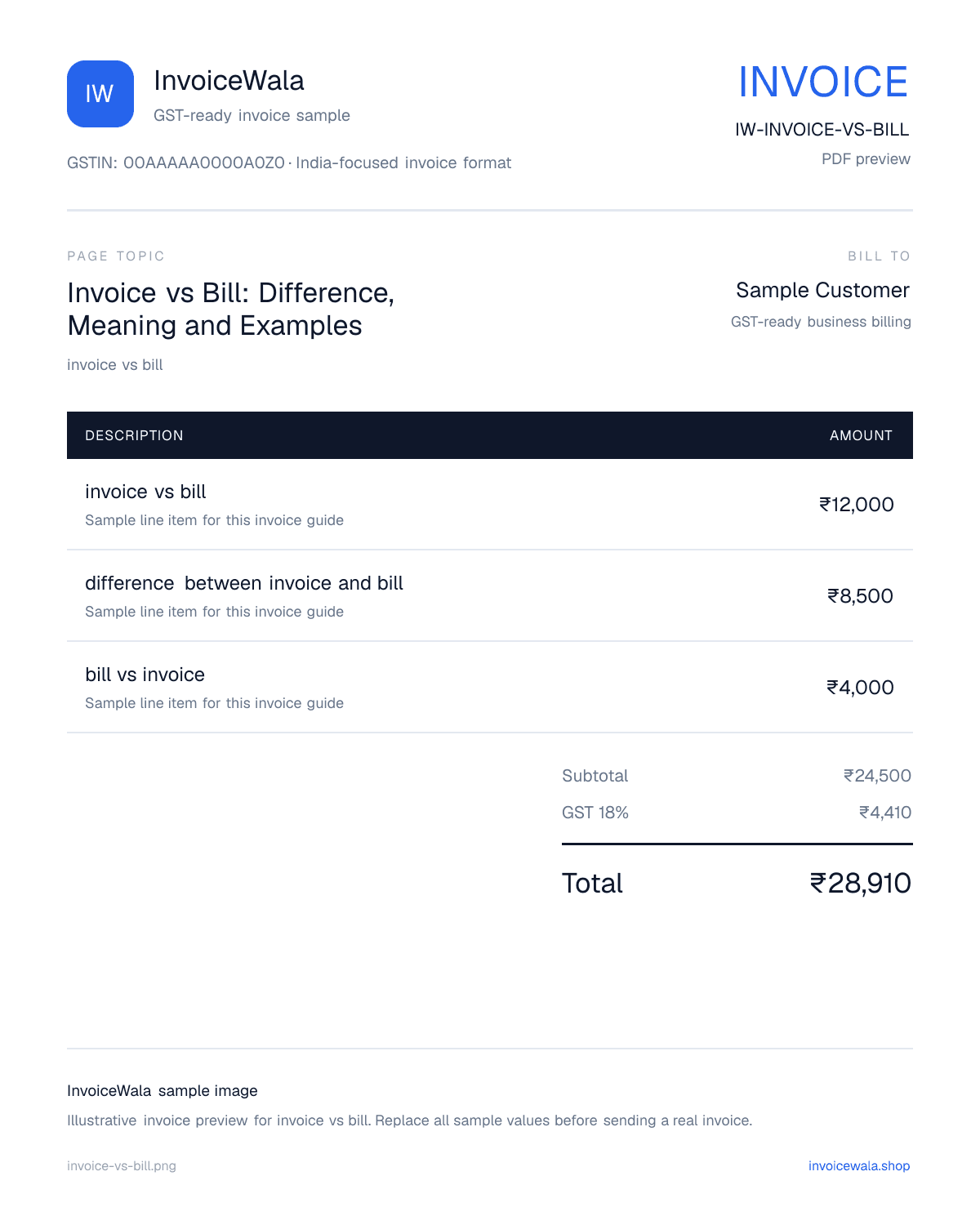
Invoice vs Bill: Difference, Meaning and Examples sample invoice preview with GST-ready fields. Sample values only.
An invoice is usually sent by a seller or service provider to ask a customer for payment, often with a due date.
A bill is commonly used in shops, restaurants, utilities or simple transactions where payment is expected immediately or already due.
A GST tax invoice is more specific and includes mandatory fields such as GSTIN, invoice number, taxable value and tax breakup.
An invoice is a formal document that lists seller details, buyer details, invoice number, date, products or services, tax, total and payment terms.
A bill usually shows the amount owed for goods or services and is often used when payment is expected immediately.
For professional client work, GST billing, repeat customers and payment tracking, invoice is usually the better term.
The exact usage can vary by industry, but this comparison works for most small businesses in India.
| Point | Invoice | Bill |
|---|---|---|
| Purpose | Request payment from customer | Show amount payable |
| Payment timing | May have due date or credit period | Often paid immediately |
| Used by | Freelancers, agencies, contractors, GST businesses | Restaurants, shops, utilities, service counters |
| Details | More structured with invoice number and terms | Can be simpler |
| GST context | GST tax invoice has mandatory fields | Bill may or may not be GST-compliant |
Invoice basics
People often say GST bill, but the formal document is usually called a GST tax invoice when it includes required GST details.
Yes, but for business records and tax discussions, structured invoices are easier to track than informal bills.
Freelancers should usually send an invoice because it includes service description, invoice number, due date and payment terms.
Retail shops may use bills or tax invoices depending on GST registration, customer requirement and transaction type.
Practical tips
Comparison
| Area | InvoiceWala | Alternative |
|---|---|---|
| Professional services | Create a PDF invoice with service details and due date. | A simple bill may look less formal for client approval. |
| GST billing | Use GST-ready fields and tax breakup. | A casual bill may miss required GST details. |
| Payment tracking | Invoice number and status make follow-up easier. | Bills are harder to track if numbering is inconsistent. |
Search intent
Explain the practical difference between invoice and bill, then guide users to create the right billing document.
Next useful step
Continue with the next practical step: calculate tax, create invoice numbers, send reminders or issue receipts.
They are often used interchangeably in casual language, but an invoice usually requests payment with structured details while a bill often shows an amount payable immediately.
A tax invoice is an invoice with tax-specific fields such as GSTIN, taxable value, GST rate and tax breakup.
For professional services, freelance work, GST billing and payment tracking, sending an invoice is usually better.
Start with a free preview. Signup only when you want to save, download the PDF and track payment.
Create a professional invoice